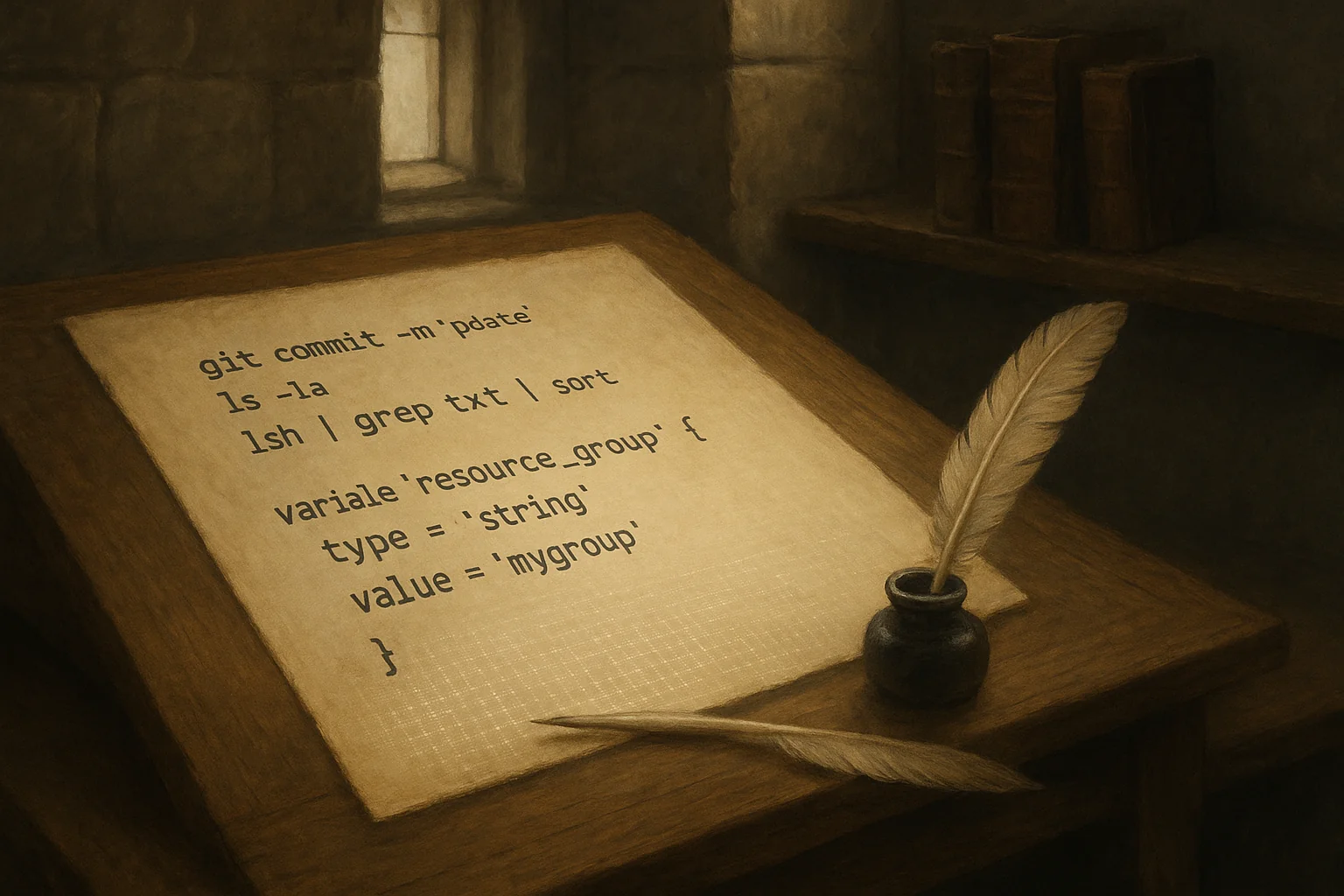
Ong 命名了那次分离。 Walter Ong 1982 年的《Orality and Literacy》确立了“书写把认知者与被认知者分开”这一点——“书写把认知者与被认知者分开,由此为‘客观性’设立了条件,这里的客观性指的是个人的抽离或拉开距离。”9 相比之下,口语文化“让思维贴近人的生活世界,把事物和议题人格化,把知识储存在故事里”。9 存在于口语文化中的知识,存在于人身上、存在于表演之中;要取用它,需要在场。存在于书写文化中的知识,存在于人工制品之中;要取用它,只需要那件制品。
Goody 命名了那个形式。 Jack Goody 1977 年的《The Domestication of the Savage Mind》确立了:系统性的清单——“离散的、有序的、在物理上被安放的、可以从多个方向阅读的”——是一种口头话语无法生成的认知形式。8“特别是,清单很少出现在口头话语中。”8 git 提交日志是清单。Terraform 配置是清单。运维手册是清单。shell 管道是清单。一段控制台点击流不是。这不是复杂度或意图的问题;这是形式的问题。清单可以被再次阅读、被查询、被与先前状态比对、被交给一个在它被写下时并不在场的人。表演不能。
《末日审判书》让产权变得可检视;基础设施即代码在同样的结构意义上让云端状态变得可检视——书面记录使得查阅无需创建者在场。10terraform plan 命令和漂移检测之所以存在,恰恰是因为 IaC 社群已经命名了“地图与疆域”的问题(书面配置可能与已部署状态不符),并建造了机制把这个差距浮到台面上。
Neal Stephenson. "In the Beginning Was the Command Line." 1999. 可在 garote.bdmonkeys.net/commandline/index.html 获取。——关于 CLI 与 GUI 哲学的经典先行文本;写给已经在用 CLI 的读者;它没有问本文所问的人群层面的问题,而这恰恰使它既是最有用的同伴,也是最有用的对照。
Michael Polanyi. The Tacit Dimension. Anchor Books, 1966.——关于“无法在个体离职后存续的具身知识”的奠基文本;提供了第 5 节所援引的团队尺度隐性知识机制(区别于 Ong 的同期群尺度稳态机制)。这两个框架在不同尺度上运作,处理的是组织知识流失的不同侧面。
Ikujiro Nonaka and Hirotaka Takeuchi. The Knowledge-Creating Company: How Japanese Companies Create the Dynamics of Innovation. Oxford University Press, 1995, 第 3–5 章。——把 Polanyi 的隐性知识传统扩展到组织知识创造;SECI 模型(社会化、外化、组合、内化)提供了一个框架,用以理解隐性知识如何成为显性的制度知识——以及为什么跳过“外化”这一步的组织,会失去其从业者曾经知道的东西。
Eric A. Havelock. Preface to Plato. Harvard University Press, 1963.——Ong 那套框架的先驱;考察古希腊由口语文化转向书写文化的认知后果;为“书写重构思想,而不只是记录思想”这一主张提供了最深的根基。
Alan Kay. "A Personal Computer for Children of All Ages." Proceedings of the ACM Annual Conference, 1972.——通用个人计算机愿景的奠基文献;阐明了为什么“用途有限的家电”与“通用机器”之间的区别,是本文的结构性主题,而不只是它的由头。
Footnotes
DataReportal / ITU, Internet Use Statistics 2024–2025;ITU Facts and Figures 2025(60 亿用户,占全球人口 74%,经新华社/EurekAlert 佐证)。Evans Data Corporation, Worldwide Developer Population Report 2025(2700 万)。SlashData, Global Developer Population and Demographic Study 2025(4720 万)。 ↩↩2
Christopher Scaffidi, Mary Shaw, and Brad A. Myers, "Estimating the Numbers of End Users and End User Programmers," IEEE Symposium on Visual Languages and Human-Centric Computing (VL/HCC), Dallas, TX, September 21–24, 2005, pp. 207–214. DOI: 10.1109/VLHCC.2005.16. 2014 年最具影响力论文奖经俄勒冈州立大学 EECS News 佐证(blogs.oregonstate.edu/eecsnews/2014/08/04/chris-scaffidis-first-paper-named-influential/)。 ↩↩2↩3
Gartner, "Citizen developers will soon outnumber professional coders 4 to 1," VentureBeat 2021 年 10 月 22 日报道,该预测出自 Gartner IT Symposium 2021 上的杰出副总裁分析师 Jason Wong。更新至 2026 年的 4∶1 时间线经引用 Gartner 的二手来源佐证。 ↩↩2
National Skills Coalition / Federal Reserve Bank of Atlanta, Closing the Digital Skill Divide, February 2023. Lightcast, Digital Skills Outlook 2024(Microsoft Office 为 15 个国家需求量第一的数字技能)。 ↩↩2
National Center for Education Statistics (NCES), Fast Facts: Adult skills in an international context (PIAAC), 2012–15 与 2017 调查周期。nces.ed.gov/fastfacts/display.asp?id=683。 ↩
Andrew J. Ko, Robin Abraham, Laura Beckwith, Alan Blackwell, Margaret Burnett, Martin Erwig, Christopher Scaffidi, Joseph Lawrance, Henry Lieberman, Brad A. Myers, Mary Beth Rosson, Gregg Rothermel, Mary Shaw, and Susan Wiedenbeck, "The State of the Art in End-User Software Engineering," ACM Computing Surveys 43, no. 3 (April 2011), Article 21. DOI: 10.1145/1922649.1922658. ↩
Jack Goody, The Domestication of the Savage Mind (Cambridge: Cambridge University Press, 1977), pp. 80–81. 引文:“特别是,清单很少出现在口头话语中”(第 80 页);清单的属性(第 81 页)。 ↩↩2↩3
Walter J. Ong, Orality and Literacy: The Technologizing of the Word (London: Methuen, 1982), 第 3 章("Some Psychodynamics of Orality"),pp. 37–49. ↩↩2
Michael T. Clanchy, From Memory to Written Record: England 1066–1307, 3rd ed. (Wiley-Blackwell, 2013). 所引段落:“国王或领主的令状抵达了英格兰的每一位执行吏和每一个村庄”;“记忆,无论是个人的还是集体的,若没有清楚的书面证据支持,都不予采信”;“世俗读写能力是从官僚制里长出来的,而不是出于任何对教育或文学的抽象渴望”;“王室财政署与法庭的要求,迫使郡中骑士与城镇市民建立起他们自己的小型官僚机构。”关于 quo warranto 的说明:相关案件在 1290 年代被中止,并承认“远至记忆所不及的保有”仍可采信;此处引用的是这一原则的确立,而非口头记忆被最终且彻底地取代。 ↩↩2↩3↩4↩5
Clanchy, From Memory to Written Record, 3rd ed. 引文:“那些使用书写的人参与了书写文化,即便他们并未掌握书记员的技艺。” ↩
Elizabeth L. Eisenstein, The Printing Press as an Agent of Change: Communications and Cultural Transformations in Early-Modern Europe (Cambridge: Cambridge University Press, 1980), 2 卷本。段落:“印刷固定性是学问迅速推进的基本前提”(第 113 页);“抄写文化如此稀薄,以致人们不得不严重依赖口头传递”(第 111 页)。反对意见见:Adrian Johns, The Nature of the Book: Print and Knowledge in the Making (University of Chicago Press, 1998);以及 AHR 论坛:Elizabeth L. Eisenstein, "An Unacknowledged Revolution Revisited," American Historical Review 107, no. 1 (February 2002): 87–105;Adrian Johns, "How to Acknowledge a Revolution," American Historical Review 107, no. 1 (February 2002): 106–125。“印刷固定性”论题在此是作为 Eisenstein 所论证的立场呈现的;“印刷比抄写文化促成了更强的标准化”这一核心主张并未被 Johns 证伪,但具体机制仍有争议。 ↩↩2
Artisan Obscura (2024);JSTOR Daily, "How the Brownie Camera Made Everyone a Photographer";富兰克林研究所柯达布朗尼藏品记录;EBSCO Research Starters(历史,Kodak Brownie)。上市:1900 年 2 月;价格:1 美元;第一年销量:15 万台以上。注:柯达那句“你只管按下按钮,剩下的交给我们”是 George Eastman 1888 年为初代 Kodak No. 1 相机所写的标语,而非 1900 年的布朗尼;布朗尼是在大众市场价位上体现了同一条原则。 ↩
GeekWire, "PageMaker pioneer Paul Brainerd, 1947–2026," February 2026;Wikipedia, "Adobe PageMaker";计算机历史博物馆,"Desktop Publishing — CHM Revolution";IEEE Annals of the History of Computing。发布日期:1985 年 1 月 23 日(苹果股东大会);发货日期:PageMaker 1.0,1985 年 7 月。Steve Jobs 的引语经 GeekWire 的 Brainerd 讣闻佐证。 ↩↩2
Rolling Stone, "Inside GarageBand, the Little App Ruling the Sound of Modern Music" (2019);MIDiA Research,2024 年 10 月(经 Music Ally、Billboard、Hypebot 转载)。发布:2004 年 1 月 6 日,Macworld。46.7% 这个数字指的是按所有权口径计算的非大厂厂牌(40.8%)与 TuneCore、Ditto Music 等艺人直发发行商(5.9%),数据来自 MIDiA Research;收入 143 亿美元(2023 年)。 ↩
Walter J. Ong, Orality and Literacy (1982), 第 3 章,约第 46 页。 ↩
browser-use 的 GitHub 仓库(browser-use/browser-use),截至 2026 年 4 月约 7.8 万个 GitHub star;Skyvern 的 Y Combinator 条目(YC S23);Claude Code:Anthropic 官方文档(anthropic.com、github.com/anthropics/claude-code);GitHub Copilot CLI:docs.github.com。Skyvern 演进的引语:“如果 Skyvern 能把自己的推理编译成代码并运行它,而不是让一个 LLM 留在循环里,自动化就会变得更快、更便宜、也更可靠”——Skyvern 博客,"Asking AI to build scrapers should be easy right?",2025 年 10 月 17 日。 ↩↩2↩3
Type Compounds; Click Doesn't
A Gradient with Bands the Reader Has Stopped Seeing#
Every computer in the world has a command line. Most people who use
computers will never see it. They will never know it is there. The shape
of computing today is the shape of a literacy gradient — with the
majority of users positioned at the appliance end, unable to see what
sits above them, and with the literate minority so accustomed to their
position that they have stopped noticing the gradient exists.
This is not new. The same pattern shaped the centuries between writing's
invention and its democratization. A scribe could produce in an hour
what an illiterate professional could not produce in a year. And the
illiterate professional did not know this. They had never seen a script.
The gradient, named precisely, runs in four bands. The appliance user
can do what the buttons allow. The pragmatic reader can compose what the
appliance user performs. The script writer can automate what the
pragmatic reader composes one step at a time. The systems author can
architect what the script writer cannot reason about.
These are not levels of intelligence. They are positions on a structured
gradient, each partly invisible to the bands below it — for the same
structural reason the pre-modern merchant could not see what the scribe
did: the knowledge required to occupy the upper band has no visible form
from the lower band.
The empirical scale of this gradient is easy to establish, even if the
bands themselves resist direct measurement. The top of the gradient —
the systems-author band, professional software developers — numbers
approximately 27 to 47 million globally, depending on the
methodology.1 Set against a
total global population of computer users that now exceeds 6 billion,
that is 0.5 to 0.9 percent of all people who use a computer at
all.1
But the systems-author band is not the literate class as a whole. Below
it, and above the appliance-user floor, sits a much larger population. A
2005 IEEE study by Scaffidi, Shaw, and Myers — named the most
influential paper at the IEEE Symposium on Visual Languages and
Human-Centric Computing in 2014 — projected that by 2012, approximately
55 million US workers would use spreadsheets or databases in ways that
constitute programming activity, and roughly 13 million would describe
themselves as programmers. Against fewer than 3 million professional
developers, that is a ratio of approximately four end-user programmers
for every professional
developer.2 Brad Myers,
one of the paper's authors, called the figures "astonishing numbers"
that "resulted in this paper being highly cited, and highly influential
in getting more researchers to focus on this class of
programmers."2 Two decades
later, Gartner predicted that citizen developers — employees who create
application capabilities using low-code, macro, and automation tools —
would outnumber professional developers by at least four to one in large
enterprises.3 The same
ratio, held for twenty years. The gradient's second band is not a
fringe. It is the dominant mode of computing production, by volume.
The labor market shows the appliance-user band with equal precision.
Analysis of 43 million US job postings found that 92 percent require at
least one digital skill; simultaneously, one-third of US workers lack
the foundational digital skills today's jobs
require.4 The most
in-demand digital skill across 15 countries — including Germany, the UK,
the US, Canada, and Australia — is Microsoft
Office.4 The
international survey of adult skills (PIAAC) found that 23 to 24 percent
of US adults perform below Level 1 in problem-solving in technology-rich
environments, meaning they can complete only the most basic single-step
tasks in familiar digital
environments.5 The
appliance-user band is not a rhetorical construction. It is a measurable
feature of the workforce.
Peer-reviewed synthesis confirms what these surveys suggest. The
field-level survey of end-user software engineering opened, in 2011, on
exactly this observation: "Most programs today are written not by
professional software developers, but by people with expertise in other
domains working towards goals for which they need computational
support."6 The gradient
is the dominant empirical condition of computing, not a conceptual
imposition on it.
The gradient's bands are not equally visible from every position on it.
Engineers who have spent a career composing scripts, pipelines, and
systems have lived for years on the literate side of a gradient most of
the people around them cannot see from where they stand. This is not an
accusation. It is a structural observation. The scribe was not
blameworthy for knowing Latin; the merchant was not deficient for not
knowing it. They occupied structurally different positions in the same
knowledge economy — and the merchant could not see the scribe's position
from the merchant's own.
What follows is an attempt to name that structure precisely enough to be
useful — not as a verdict, but as a diagnostic instrument.
The difference between a GUI application and a command-line interface is
not, primarily, a difference in aesthetic preference or ergonomic
efficiency. It is a difference in what the interface claims the machine
can do.
A GUI application presents a finished surface. The file menu, the
ribbon, the dialog box — these are the interface's implicit argument
about the machine's possibilities. The user who operates within that
surface is operating within a claim about what the machine is for. The
surface is not false, but it is bounded: the GUI's claim about the
machine's capabilities is the machine's packaged capabilities, not the
machine's actual generativity.
The CLI presents the seam directly. Every command is a call to a
program; every user who can compose commands can compose programs. The
interface does not enumerate the machine's possibilities — it exposes
the mechanism by which possibilities are composed. This is the
structural difference the gradient is built on: not that one interface
is faster or more efficient, but that one interface presents the machine
as a programmable surface and the other presents it as a fixed-function
appliance.
The shell-scripting population, even among the most technically inclined
sample available — the Stack Overflow Developer Survey, with more than
65,000 respondents across 185 countries — stands at 33.9 percent of all
respondents using Bash or Shell for extensive development
work.7 Even within
this developer-biased population, the literate-shell band is well below
universal. Read as a ceiling on CLI use, not as a population estimate,
this figure tells the gradient's story precisely: even among people who
have every incentive to know the CLI, two-thirds do not compose in
shell.
The hardest counter to the gradient framing must be named and absorbed
here: every major GUI ecosystem contains its own internal gradient.
Microsoft Excel has had VBA since 1993. Apple has had AppleScript since
the same year. Microsoft Office has had Power Automate since 2016. Mac
added Automator in 2005 and Shortcuts in 2018. Google Workspace has had
Apps Script since 2012. The 4:1 ratio documented by Scaffidi, Shaw, and
Myers — and confirmed by Gartner two decades later — is largely the
population of people who have moved into these composability
layers.23 The VBA
writer is not at the appliance-user band. The Excel formula writer is
not at the appliance-user band. They are at the pragmatic-reader band,
producing persistent instructions the machine then executes.
The structural claim is sharper than "the GUI hides programmability."
The sharper claim is this: the GUI's surface conceals the gradient
above it, and most users never find the first step up. The spreadsheet
is itself a list — in Jack Goody's precise technical sense, a cognitive
form that oral discourse cannot
generate.8 The VBA macro
is a written program. The pragmatic reader who has crossed onto the
composability layer is genuinely at a different gradient position than
the appliance user. But the appliance user has no view of that position.
The default surface of the GUI presents nothing that requires stepping
up, and the first step is invisible from the outside.
Every band above the appliance-user end has this property: visible from
the band above, invisible from the band below. The script writer can see
what the formula writer cannot see. The systems author can see what the
script writer cannot see. And the engineer who lives and works in this
structure has stopped seeing that it is a structure — because it is the
air they breathe.
Why knowledge generated above the appliance band accumulates while
knowledge generated at the appliance band disappears with the
practitioner who held it — that question requires a mechanism. The
mechanism comes from a vocabulary forty years old.
Writing Separates the Knower from the Known: The Mechanism#
The structural observation — that the gradient's bands are invisible
from below, that knowledge generated in CLI accumulates while knowledge
generated in GUI disappears with the practitioner — is not a metaphor.
It has a mechanism. The mechanism has been named, in different
registers, by three bodies of scholarship. Each names something the
practitioner vocabulary cannot.
Ong names the separation. Walter Ong's 1982 Orality and Literacy
established that writing separates the knower from the known — "Writing
separates the knower from the known and thus sets up conditions for
'objectivity', in the sense of personal disengagement or
distancing."9 Oral
cultures, by contrast, "keep their thinking close to the human
life-world, personalizing things and issues, and storing knowledge in
stories."9 The knowledge
that exists in an oral culture exists in persons and in performances; to
retrieve it requires presence. The knowledge that exists in a literate
culture exists in artifacts; to retrieve it requires only the artifact.
Applied to computing, this is not an analogy. It is a mechanism. The
shell script externalizes the procedure into an inspectable artifact.
The click session keeps the procedure embodied in the practitioner's
performance. The script accumulates; the click session does not. When
the engineer leaves, the script remains. When the GUI practitioner
leaves, the knowledge they carried — which interface they clicked, in
which order, under which circumstances — leaves with them. Ong's
framework names why this happens at the level of form, not preference.
Goody names the form. Jack Goody's 1977 The Domestication of the
Savage Mind established that the systematic list — "discontinuous,
ordered, physically placed, readable in multiple directions" — is a
cognitive form oral discourse cannot
generate.8 "In
particular, the list rarely appears in oral
discourse."8 The git
commit log is a list. The Terraform configuration is a list. The runbook
is a list. The shell pipeline is a list. A console clickstream is not.
This is not a question of complexity or intent; it is a question of
form. The list can be read again, queried, compared against a prior
state, handed to someone who was not present when it was composed. The
performance cannot.
This is also what resolves the counter that modern GUI applications have
audit logs — that CloudTrail records what was clicked in the AWS
Console, that Figma keeps version histories. A log records a
performance. A script composes a performance. They are different kinds
of artifacts: a log of what was clicked cannot be re-executed as a new
configuration; a Terraform file can be. Goody's distinction between the
list as cognitive form and the oral utterance as performance does this
work at the level of structure, not technology preference.
Clanchy names the pattern. The structural mapping between CLI/IaC
practice and literate knowledge architecture has been documented, in one
of the most meticulously studied transitions in administrative history,
by Michael Clanchy's From Memory to Written Record: England 1066–1307.
Clanchy documents the specific mechanisms by which oral administration —
witnessed oral oaths, memory, the testimony of those present — was
superseded by written instruments over two and a half centuries of
English governance. The correspondence between that transition and
computing's current CLI/IaC transition is structural, not decorative:
The oral oath required all parties to be present; it was unreplayable
without them. The click session requires the person who clicked; it
cannot be reproduced without their memory. The written charter was
persistent, transmissible, inspectable without the original drafter. By
Edward I's reign, Clanchy documents, "royal or seignorial writs reached
every bailiff and village in England, making writing familiar throughout
the
countryside."10 The shell
script is persistent, version-controlled, auditable without the engineer
who wrote it.
The Domesday Book — William the Conqueror's 1086 written survey of
England's landholdings — made property rights inspectable without
requiring the original witnesses. Infrastructure-as-code makes cloud
state inspectable without requiring the engineer who provisioned it. The
written record, in both cases, is not a mere transcription; it is a
governance mechanism.
The quo warranto proceedings of Edward I's reign formalized what the
practice of written administration had been making operationally true
for a century: "Memory, whether individual or collective, if unsupported
by clear written evidence, was ruled out of
court."10 An oral
account of what privileges one held — without a written warrant — was
legally insufficient. The principle established was that written record
supersedes oral memory as the authoritative account of what was
done.10 Today's
compliance audit demands IaC state for the same reason: an oral account
of which infrastructure was provisioned is legally and operationally
insufficient absent a written record of it.
And Clanchy's most precise finding for computing's case: "Lay literacy
grew out of bureaucracy, rather than from any abstract desire for
education or
literature."10 CLI adoption
has followed the same mechanism: not mass training programs, but the
expanding administrative requirement to produce written artifacts —
DevOps practice that demands version-controlled infrastructure, cloud
governance that requires inspectable state, compliance frameworks that
treat click sessions as insufficient.
Clanchy also documents the gradient's internal structure in medieval
England with a precision that maps directly onto computing's. The
medieval literate world was not binary — scribes on one side,
illiterates on the other. It was tripartite: the professionally literate
scribe who could produce documents, the pragmatic reader who used
documents without producing them, and the fully illiterate who
nonetheless participated in written culture through surrogates. "Those
who used writing participated in literacy, even if they had not mastered
the skills of a
clerk."11 The Excel
formula writer participates in the literate computing world even if they
have not mastered the shell. The VBA macro author is a pragmatic reader.
The gradient has always had multiple named bands — and each band has
always been partly invisible to the bands below it.
The structural template is the same: the expansion of the population
that needs to produce written artifacts, driven not by education but by
the practical requirement of administration. Eisenstein argued that the
printing press enabled "typographical fixity" — a mechanism for the
systematic accumulation and correction of knowledge that scribal culture
could not
provide.12 The Clanchy
anchor does not depend on whether that thesis survives the Johns
critique: Clanchy's argument is about administrative practice, not
mechanical fixity theory.
Computing is going through what England went through between 1066 and
1307. This is not a paradigm shift. It is a structural recurrence of a
pattern that has run before — a slow, contested, need-driven expansion
of the population that has to produce written artifacts, with the
gradient expanding not through universal instruction but through
administrative necessity.
The recurrence frame matters because it disciplines the claim. Three
production-side democratizations have run within living memory, and each
illustrates the pattern and its limits.
In 1900, Kodak released the Brownie camera at one dollar. Photography
had required bulky equipment, glass plates, toxic chemical development,
and specialist training. The Brownie absorbed the specialist's work into
the appliance: Kodak processed the film at its own facilities; the
customer pressed the shutter. More than 150,000 Brownie cameras shipped
in the first
year.13 The snapshot
came to the masses. Professional photography did not disappear.
Cinematography remained scarce. The threshold for one finite skill
dropped to mass-market price. The ceiling of what the new population
could do with that skill remained finite.
In 1985, Aldus PageMaker was announced at the Apple stockholders meeting
on January 23 and shipped its first version in July of that
year.14 Before
PageMaker, professional-quality documents required typesetters with
specialized equipment and training. After PageMaker, an office worker
with a Mac and a LaserWriter could produce typeset-quality layouts. Paul
Brainerd coined the term "desktop publishing." Steve Jobs later said
desktop publishing had saved the
Macintosh.14 The
typesetting industry contracted significantly over the following decade.
The threshold for producing formatted documents dropped to any Mac user.
The ceiling of what that population could do with PageMaker — layouts,
yes; typesetting software, no — remained finite.
In 2004, Apple launched GarageBand, free with every Mac, explicitly to
"democratize music-making." By 2023, non-major labels and independent
distributors — a category that includes independent labels at 40.8
percent and artist-direct distributors at 5.9 percent, not solely
individual independent artists — commanded 46.7 percent of the global
recorded music market by ownership basis, with revenues of $14.3
billion.15 The home
studio threshold dropped to zero for Mac users. The threshold for
composing at the level of Logic Pro did not.
Each democratization has the same structure. A finite skill, previously
requiring specialist knowledge, is absorbed into an appliance. The
non-specialist gains access to a specific finite ceiling of that skill.
The specialist-level practice — cinematography, typesetting software
development, professional music production at the highest register —
remains scarce.
Eisenstein argued that the printing press operated differently — not as
a production-side democratization but as a consumption-side
one.12 Print
lowered the threshold for reading, not for writing. It made reading
worth learning because there were now things worth reading at affordable
prices. Writing remained scarce after print; even a published author in
1600 was likely one of a handful in their parish who could draft a
letter. The press did not teach illiterates to write. It ended the
scribal monopoly on reading, not on writing.
The CLI/GUI gradient is structurally different from any of these
precedents. The CLI is not a finite-purpose tool with a fixed ceiling.
It is the operator's interface to a general-purpose machine — which is
why the gradient has so many bands, why those bands keep extending
upward, and why the question of what counts as the "top" remains
genuinely open. The Brownie's ceiling was cinematography. The CLI's
ceiling is whatever the systems author is currently building above the
script writer.
When the Gradient Matters: The Organizational Face and the Scope Conditions#
The structural argument has an organizational face that engineers in
CLI-literate positions have been living inside, without quite having the
vocabulary for its structural cause.
Teams staffed predominantly by appliance-end users — engineers managing
cloud infrastructure through the AWS Console, organizations whose
institutional knowledge lives in practitioner performance rather than in
inspectable artifacts — are running oral-culture knowledge architectures
at contemporary scale. The pathologies have names in practitioner
discourse: ClickOps, tribal knowledge, orphaned resources, the engineer
who left and took the runbook with them. What the practitioner
vocabulary does not supply is the structural cause of these failures.
The structural cause is that knowledge generated in oral practice is
homeostatic. Ong observed that "oral societies live very much in a
present which keeps itself in equilibrium or homeostasis by sloughing
off memories which no longer have present
relevance."16 Applied at
cohort scale — the 3-to-5-year cycles through which team membership
turns over — this mechanism describes what happens to organizations
whose operational knowledge exists only in practitioner performance. The
knowledge that nobody currently rehearses is lost when the cohort who
held it moves on. At the individual departure scale, a different
mechanism applies: this is the failure mode that the tacit-knowledge
tradition, from Michael Polanyi's The Tacit Dimension to Nonaka and
Takeuchi's The Knowledge-Creating Company, describes — embodied
knowledge that does not survive individual departure because it was
never externalized into an inspectable artifact. Both mechanisms,
operating at different scales, produce the same kind of organizational
outcome: knowledge that cannot be retrieved because it was never written
down.
The organizational survey evidence is consistent with this structural
diagnosis. Industry data from 2025 estimates that 21 percent of
enterprise cloud infrastructure spend — equivalent to approximately
$44.5 billion against Gartner's cloud spending forecast for the year —
is wasted on underutilized, idle, or orphaned
resources.17 In the same
survey, fewer than half of organizations reported having real-time data
on idle resources (43 percent), unused or orphaned resources (39
percent), or over-provisioned workloads (33
percent).17 Only 32
percent of developers reported having fully automated cost-saving
practices.17
The Domesday Book made property rights inspectable;
Infrastructure-as-Code makes cloud state inspectable in the same
structural sense — the written record enables consultation without
requiring the presence of whoever created
it.10 The
terraform plan command and drift detection exist precisely because the
IaC community has named the map-versus-territory problem (the written
configuration may not match the deployed state) and built mechanisms to
surface the gap.
But the gradient is a diagnostic instrument, not a universal verdict.
The scope conditions matter.
The gradient matters when the same task is done many times — when
automation has positive return on investment. It matters when the work
needs to be inspected, audited, or transferred to someone who was not
present when it was performed. It matters when the worker's situation
will change — when the literate skill is transferable in a way the
performance is not. It matters when the scale exceeds the operator's
sustained attention — when the gap between what the human can track
manually and what the system requires has grown past what liveware can
bridge.
The gradient matters much less when the task is genuinely one-off. It
matters less when the worker's domain specialization pays better than
the automation savings — when the accountant's time is worth more as
accounting than as VBA. It matters less when the rational response is
delegation to a specialist — the merchant/scribe model, which was
economically efficient rather than a failure of literacy aspiration. The
medieval merchant who dictated contracts to a scribe was specializing,
not failing. The scribe was specializing too. Division of labor creates
wealth; the gradient is not a verdict against specialization.
In the situations where the gradient matters — repetition, audit,
transfer, scale — the oral-culture knowledge architecture produces
predictable organizational failures, and those failures have a
structural cause the practitioner vocabulary names but does not explain.
What the oral/literate framework supplies is the explanation.
The Open Question: Brownie-Like, Press-Like, or Genuinely New#
The gradient has survived every prior threshold-lowering event.
Photography's democratization did not dissolve the distinction between a
snapshot and a cinematography practice. Desktop publishing's
democratization did not dissolve the distinction between a formatted
newsletter and a typesetting program. Home recording's democratization
did not dissolve the distinction between a GarageBand track and a Logic
Pro mastering session.
Two distinct LLM agent architectures have now emerged, and the
distinction between them maps directly onto the oral/literate
distinction between accumulated artifact and ephemeral performance.
Browser-driving agents — Browser-Use (the Python library, with
approximately 78,000 GitHub stars as of April 2026) and Skyvern (Y
Combinator-backed, "computer vision plus LLMs") — interact with
interfaces via screenshots and
clicks.18 They
preserve the oral-clicky pattern at the agent layer. The agent navigates
the GUI the way a practitioner navigates the GUI: it sees a screen,
identifies clickable elements, issues clicks, and moves forward. The
procedure the agent executes does not accumulate as an inspectable
artifact. It is a performance.
Script-generating agents — Claude Code (Anthropic's terminal-based
agentic coding tool, which plans and executes sequences of actions
including file creation, multi-file refactoring, test execution, and git
operations) and GitHub Copilot CLI (which brings AI-powered coding
assistance directly to the command line) — generate executable,
inspectable
scripts.18 The
procedure the agent produces is a written artifact:
version-controllable, auditable, reproducible without the agent's
presence for re-execution.
Skyvern's own evolution is instructive. The company's blog from October
2025 documents the reasoning: "If Skyvern could compile its reasoning
into code and run that instead of keeping an LLM in the loop,
automations would become faster, cheaper, and more
reliable."18 When
reproducibility and inspectability matter — when the oral-pattern
agent's output needs to be rerun reliably — the agent wants to write a
script. The structural distinction persists even inside a product that
began as a browser-driver.
The gradient has survived the LLM transition. The oral/literate
distinction is being reproduced at the agent layer with the same
structural properties — replayability, inspectability, transmissibility
without the original author — that distinguished the written charter
from the oral oath in Clanchy's England.
Whether the LLM moment is Brownie-like or genuinely new remains the open
question.
If the LLM moment is Brownie-like, it democratizes a finite slice of
computing practice. Non-coders write small one-off scripts — the way the
Brownie user took snapshots — and the systems-author band remains as
distant and scarcely populated as it is today. The gradient gains a
band: the prompt engineer as the new pragmatic reader, able to compose
what the appliance user cannot, unable to architect what the systems
author can. The recurrence runs again.
If the LLM moment is genuinely new — the first time in history that the
production threshold for general-purpose programmable instruction has
been lowered for a population that did not previously cross it — then
the gradient is being remade. Not populated with a new band. Remade.
The LLM moment is the only candidate in this sequence that might
dissolve a gradient rather than merely populate it — because it lowers a
threshold for producing general-purpose instruction, not a threshold
for consuming a finite-ceiling skill. Whether it does is not yet
visible. The bifurcation at the agent layer is the leading indicator:
each new agent that ships either preserves the gradient or extends it.
The browser-driver preserves the oral pattern. The script-generator
preserves the literate pattern. Each architectural choice is a data
point in the question's resolution.
The press ended the scribal monopoly on reading; writing stayed scarce.
The Brownie ended the darkroom's monopoly on snapshots; cinematography
stayed scarce. Whether the LLM moment ends the scribal monopoly on the
general-purpose machine — or merely adds a new band to an old gradient —
is not yet visible. The literate band is the band best positioned to
watch the answer emerge.
DataReportal / ITU, Internet Use Statistics 2024–2025; ITU Facts
and Figures 2025 (6 billion users, 74% of global population,
confirmed via Xinhua/EurekAlert). Evans Data Corporation, Worldwide
Developer Population Report 2025 (27 million). SlashData, Global
Developer Population and Demographic Study 2025 (47.2 million).
↩︎↩︎
Christopher Scaffidi, Mary Shaw, and Brad A. Myers, "Estimating the
Numbers of End Users and End User Programmers," IEEE Symposium on
Visual Languages and Human-Centric Computing (VL/HCC), Dallas, TX,
September 21–24, 2005, pp. 207–214. DOI: 10.1109/VLHCC.2005.16. Most
Influential Paper award 2014 confirmed via Oregon State University
EECS News
(blogs.oregonstate.edu/eecsnews/2014/08/04/chris-scaffidis-first-paper-named-influential/).
↩︎↩︎↩︎
Gartner, "Citizen developers will soon outnumber professional coders
4 to 1," reported in VentureBeat, October 22, 2021, attributing
prediction to Jason Wong, Distinguished VP Analyst, at Gartner IT
Symposium 2021. Updated 4:1 timeline through 2026 confirmed via
Gartner-citing secondary sources.
↩︎↩︎
National Skills Coalition / Federal Reserve Bank of Atlanta,
Closing the Digital Skill Divide, February 2023. Lightcast,
Digital Skills Outlook 2024 (Microsoft Office #1 demanded digital
skill across 15 countries).
↩︎↩︎
National Center for Education Statistics (NCES), Fast Facts: Adult
skills in an international context (PIAAC), 2012–15 and 2017 survey
cycles. nces.ed.gov/fastfacts/display.asp?id=683.
↩︎
Andrew J. Ko, Robin Abraham, Laura Beckwith, Alan Blackwell,
Margaret Burnett, Martin Erwig, Christopher Scaffidi, Joseph
Lawrance, Henry Lieberman, Brad A. Myers, Mary Beth Rosson, Gregg
Rothermel, Mary Shaw, and Susan Wiedenbeck, "The State of the Art in
End-User Software Engineering," ACM Computing Surveys 43, no. 3
(April 2011), Article 21. DOI: 10.1145/1922649.1922658.
↩︎
Stack Overflow, 2024 Developer Survey, Technology section (65,437
total respondents, 185 countries).
survey.stackoverflow.co/2024/technology. Bash/Shell: 33.9% of all
respondents; 34.2% of professional developers.
↩︎
Jack Goody, The Domestication of the Savage Mind (Cambridge:
Cambridge University Press, 1977), pp. 80–81. Quote: "In particular,
the list rarely appears in oral discourse" (p. 80); list properties
(p. 81). ↩︎↩︎↩︎
Walter J. Ong, Orality and Literacy: The Technologizing of the
Word (London: Methuen, 1982), Chapter 3 ("Some Psychodynamics of
Orality"), pp. 37–49.
↩︎↩︎
Michael T. Clanchy, From Memory to Written Record: England
1066–1307, 3rd ed. (Wiley-Blackwell, 2013). Passages cited: "royal
or seignorial writs reached every bailiff and village in England";
"Memory, whether individual or collective, if unsupported by clear
written evidence, was ruled out of court"; "Lay literacy grew out of
bureaucracy, rather than from any abstract desire for education or
literature"; "The demands of the royal Exchequer and courts of law
compelled knights in the shires and burgesses in the towns to create
lesser bureaucracies of their own." Quo warranto note: cases were
suspended in the 1290s with acknowledgment that "tenure from time
out of mind" remained admissible; cited here as the principle being
established, not oral memory finally and fully displaced.
↩︎↩︎↩︎↩︎↩︎
Clanchy, From Memory to Written Record, 3rd ed. Quote: "Those who
used writing participated in literacy, even if they had not mastered
the skills of a clerk."
↩︎
Elizabeth L. Eisenstein, The Printing Press as an Agent of Change:
Communications and Cultural Transformations in Early-Modern Europe
(Cambridge: Cambridge University Press, 1980), 2 vols. Passages:
"Typographical fixity is a basic prerequisite for the rapid
advancement of learning" (p. 113); "scribal culture was so thin that
heavy reliance was placed on oral transmission" (p. 111). Contested
by: Adrian Johns, The Nature of the Book: Print and Knowledge in
the Making (University of Chicago Press, 1998); and the AHR Forum:
Elizabeth L. Eisenstein, "An Unacknowledged Revolution Revisited,"
American Historical Review 107, no. 1 (February 2002): 87–105;
Adrian Johns, "How to Acknowledge a Revolution," American
Historical Review 107, no. 1 (February 2002): 106–125. The
"typographical fixity" thesis is presented here as Eisenstein's
argued position; the core claim that print enabled greater
standardization than scribal culture is not falsified by Johns, but
the specific mechanism is contested.
↩︎↩︎
Artisan Obscura (2024); JSTOR Daily, "How the Brownie Camera Made
Everyone a Photographer"; Franklin Institute Kodak Brownie
collection record; EBSCO Research Starters (history, Kodak Brownie).
Launch: February 1900; price: $1; first-year sales: 150,000+. Note:
the Kodak slogan "You press the button, we do the rest" was George
Eastman's 1888 tagline for the original Kodak No. 1 camera, not the
1900 Brownie; the Brownie embodied the same principle at a
mass-market price point.
↩︎
GeekWire, "PageMaker pioneer Paul Brainerd, 1947–2026," February
2026; Wikipedia, "Adobe PageMaker"; Computer History Museum,
"Desktop Publishing — CHM Revolution"; IEEE Annals of the History
of Computing. Announcement date: January 23, 1985 (Apple
stockholders meeting); ship date: PageMaker 1.0, July 1985. Steve
Jobs quote confirmed via GeekWire Brainerd obituary.
↩︎↩︎
Rolling Stone, "Inside GarageBand, the Little App Ruling the Sound
of Modern Music" (2019); MIDiA Research, October 2024 (via Music
Ally, Billboard, Hypebot). Launch: January 6, 2004, Macworld. The
46.7% figure refers to non-major labels (40.8%) and artist-direct
distributors such as TuneCore and Ditto Music (5.9%) on ownership
basis, as reported by MIDiA Research; $14.3 billion in revenues
(2023). ↩︎
Walter J. Ong, Orality and Literacy (1982), Chapter 3,
approximately p. 46.
↩︎
Harness, "FinOps in Focus 2025," press release via PR Newswire,
February 2025. Survey: 700 respondents (350 developers, 350
engineering leaders), US and UK, organizations with 1,000+
employees, conducted by Coleman Parkes Research,
November–December 2024. $44.5B = 21% waste rate applied to
Gartner's 2025 worldwide public cloud end-user spending forecast
($211.86B); this is a model output, not a measured figure.
↩︎↩︎↩︎
browser-use GitHub repository (browser-use/browser-use),
approximately 78,000 GitHub stars as of April 2026; Skyvern Y
Combinator listing (YC S23); Claude Code: Anthropic primary
documentation (anthropic.com, github.com/anthropics/claude-code);
GitHub Copilot CLI: docs.github.com. Skyvern evolution quote: "If
Skyvern could compile its reasoning into code and run that instead
of keeping an LLM in the loop, automations would become faster,
cheaper, and more reliable" — Skyvern blog, "Asking AI to build
scrapers should be easy right?", October 17, 2025.
↩︎↩︎↩︎
Neal Stephenson. "In the Beginning Was the Command Line." 1999.
Available at garote.bdmonkeys.net/commandline/index.html. — The
canonical prior text on CLI versus GUI philosophy; addressed to the
reader who already uses the CLI; does not ask the population-level
question this article asks, which makes it the most useful companion
and the most useful contrast.
Michael Polanyi. The Tacit Dimension. Anchor Books, 1966. — The
foundational text on embodied knowledge that does not survive
individual departure; supplies the team-scale tacit-knowledge
mechanism referenced in §5 (as distinct from Ong's cohort-scale
homeostatic mechanism). The two frameworks operate at different scales
and address different aspects of organizational knowledge loss.
Ikujiro Nonaka and Hirotaka Takeuchi. The Knowledge-Creating Company:
How Japanese Companies Create the Dynamics of Innovation. Oxford
University Press, 1995, Chapters 3–5. — Extends Polanyi's
tacit-knowledge tradition to organizational knowledge creation; the
SECI model (Socialization, Externalization, Combination,
Internalization) provides the framework for understanding how tacit
knowledge becomes explicit institutional knowledge — and why
organizations that skip the Externalization step lose what their
practitioners knew.
Eric A. Havelock. Preface to Plato. Harvard University Press, 1963.
— The precursor to Ong's framework; examines the cognitive
consequences of the shift from oral to written culture in ancient
Greece; provides the deepest grounding for the claim that writing
restructures thought rather than merely recording it.
Alan Kay. "A Personal Computer for Children of All Ages." Proceedings
of the ACM Annual Conference, 1972. — The founding document of the
general-purpose personal computer vision; articulates why the
distinction between finite-purpose appliance and general-purpose
machine is the article's structural subject, not merely its occasion.