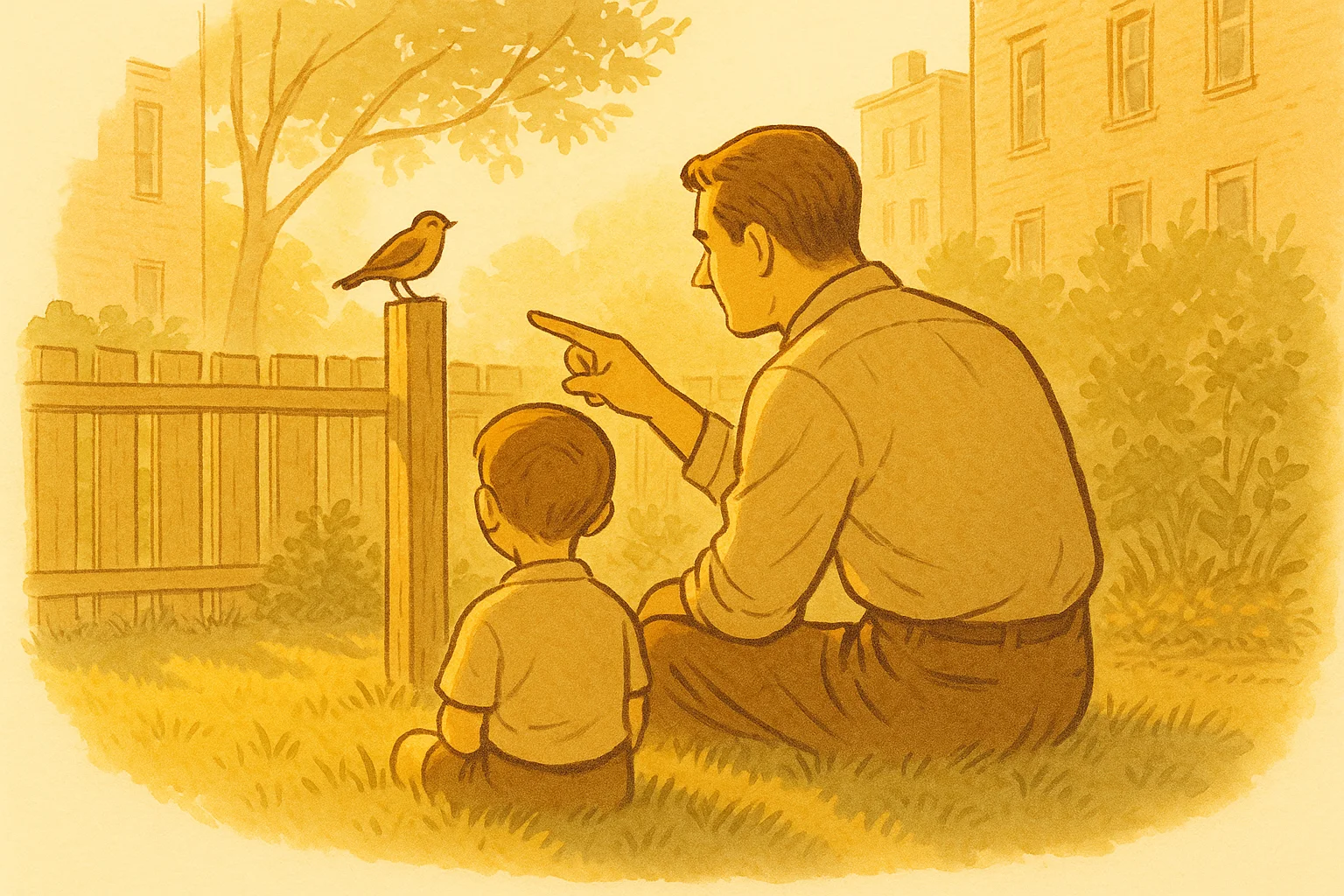
当你问 AI 一件事、而它给了你一个答案时,你有一个选择。接受这个答案,关掉标签页。或者,问那个机制问题——费曼的父亲在院子里问的那个问题。1 不是“这个答案对不对”——你才十二岁,你常常判断不了,而且你也不需要判断。就只是:问下一个。“可它为什么是那样运作的?”
你不是在审计这个 AI。你是在给它重新指向。
研究背景是这样的:Yurt 和 Kuşci 2026 年发表在《Current Psychology》上的一项研究发现,不加反思就使用 AI 的大学生,批判性思维会下降,其中介是研究者所称的“认知懒惰”——接受 AI 的答案,而不去往下推它。11 样本是大学生,不是十二岁的孩子。我在推断这个机制开始得更早。我可能是错的。我认为我没错的理由是:Ron Aboodi 2025 年发表在《Educational Theory》上的一篇论文论证,习惯性地把思考外包给 AI,会形成一种累积性的性情倾向,而不只是一次瞬时的抄近路——你十二岁时怎么对待答案,可能会塑造你三十岁时怎么对待答案。12 Aboodi 的论证是理论性的,不是经验性的。这意味着它是一个细致的哲学论证,而不是一项对照研究。我把这个区别告诉你,好让你自己去掂量。
研究显示的是:懒惰地使用 AI 与思考能力下降相关。它还没有显示出:有策展意识地使用 AI 能保住思考能力。这是我做的一个不对称的推断。你可以这样去检验它:在一次 AI 会话之后,注意一下你走开时带走的是一个新问题,还是只是一份做完的作业。那就是你的数据。如果这个两种模式的区分与你实际经验到的东西吻合,那这个机制就抓住了某种真实的东西。如果不吻合,那我描述的就是一件并没有发生在你身上的事,你也应该据此调低我这个论证的分量。
这个动作在实践中是这样的。你问 AI 红石比较器是怎么工作的。它告诉你了。你可以说“懂了,谢谢”——于是你现在拥有一个标签。比较器会比较。你也可以说:“可它为什么是那样比较的?它在电路内部实际测量的到底是什么?”现在这个 AI 成了你所在意的那个问题里的一个活的伙伴。你不是在检索一个答案。你是在追一个机制。同一件工具,两种模式。
另见:Smith, Z. R., et al. (2023). Academic motivation decreases across adolescence for youth with and without ADHD. Journal of Child Psychology and Psychiatry. https://doi.org/10.1111/jcpp.13815
支撑材料:García-Álvarez, J., & Acevedo-Borrega, J. (2025). Minecraft as a pedagogical tool: A systematic literature review (2014–2024). Journal of Educational Computing Research. https://journals.sagepub.com/doi/10.1177/15554120251341034
Csikszentmihalyi, M. (1990). Flow: The Psychology of Optimal Experience. Harper & Row.——关于心流状态的原始材料:它是什么感觉,什么时候发生,以及为什么即便结构性前提具备,学校条件也无法可靠地产生它。如果《我的世界》那一节戳到你了,下一步该去这里。
Deci, E. L., & Ryan, R. M. (2000). The "what" and "why" of goal pursuits: Human needs and the self-determination of behavior. Psychological Inquiry, 11(4), 227–268.——第 3、4 节通篇所用的“自主—胜任—归属”框架背后的研究传统。比本文更技术性,但对一个有动力的成年人来说读得下去。
Feynman, R. P. (1985). Surely You're Joking, Mr. Feynman! W. W. Norton & Company.——那本讲鸟的书的姊妹篇。如果你想知道更多费曼的好奇心在实践中如何运作——他怎么在洛斯阿拉莫斯撬锁、怎么学画画、怎么打邦戈鼓——就是这本。
Blakemore, S-J. (2018). Inventing Ourselves: The Secret Life of the Teenage Brain. PublicAffairs.——本文必须吸收的那个反面论证:为什么青少年动机的下降有一部分只是长大,而不全是学校造成的。Blakemore 是写给普通读者的,而且她认真对待青少年的大脑。
Bowen, E., et al. (2025). Building AI Literacy at Home: How Families Navigate Children's Self-Directed Learning with AI. arXiv 2510.24070.——那项发现小学生还无法独立评估 AI 输出的研究——而这恰恰是本文把门槛降到“问下一个问题”的原因。如果你想看 AI 与儿童这场争论的另一面,值得一读。
Footnotes
Feynman, R. P.(由 R. Leighton 记述)。(1988). What Do You Care What Other People Think?: Further Adventures of a Curious Character. W. W. Norton & Company.“The Making of a Scientist”,第 13–14 页(据二手来源)。 ↩↩2↩3↩4
Randolph, J. J., et al. (2023). Montessori education's impact on academic and nonacademic outcomes: A systematic review. Campbell Systematic Reviews, 19(3), e1330. https://doi.org/10.1002/cl2.1330↩
White, E. J., Hutka, S. A., Williams, L. J., & Moreno, S. (2013). Learning, neural plasticity and sensitive periods: implications for language acquisition, music training and transfer across the lifespan. Frontiers in Systems Neuroscience, 7, 90. https://pmc.ncbi.nlm.nih.gov/articles/PMC3834520/↩↩2
Lepper, M. R., Greene, D., & Nisbett, R. E. (1973). Undermining children's intrinsic interest with extrinsic reward: A test of the "overjustification" hypothesis. Journal of Personality and Social Psychology, 28(1), 129–137. https://psycnet.apa.org/record/1974-10497-001↩↩2
Gnambs, T., & Hanfstingl, B. (2016). The decline of academic motivation during adolescence: An accelerated longitudinal cohort analysis on the effect of psychological need satisfaction. Educational Psychology, 36(9), 1691–1705. https://doi.org/10.1080/01443410.2015.1113236↩
Knudsen, E. I. (2004). Sensitive periods in the development of the brain and behavior. Journal of Cognitive Neuroscience, 16(8), 1412–1425. https://doi.org/10.1162/0898929042304796↩
Csikszentmihalyi, M. (1990). Flow: The Psychology of Optimal Experience. Harper & Row. 另见:Csikszentmihalyi, M., & Larson, R. (1984). Being Adolescent. Basic Books. ↩
Yurt, E., & Kuşci, I. (2026). Factors influencing critical thinking during AI use among university students: the mediating effects of epistemic laziness and metacognitive weakness. Current Psychology, 45. https://doi.org/10.1007/s12144-025-08800-0↩
Aboodi, R. (2025). The worrisome potential of outsourcing critical thinking to artificial intelligence. Educational Theory, 75, 626–645. https://doi.org/10.1111/edth.70037↩
A small boy is sitting in a yard in Brooklyn with his father, sometime
in the 1930s. A bird lands on a fence post nearby. The father starts
naming it — in Italian, then Portuguese, then Chinese, then Japanese.
Four languages, four names, all very impressive.
Then the father says something the boy never forgot. As Feynman tells it
in What Do You Care What Other People Think?, his father said: "You
can know the name of that bird in all the languages of the world, but
when you're finished, you'll know absolutely nothing whatever about the
bird. You'll only know about humans in different places, and what they
call the bird. So let's look at the bird and see what it's doing —
that's what
counts."1
The boy grew up to be Richard Feynman — physicist, Nobel laureate, the
person who demonstrated the O-ring failure in the Challenger disaster by
dunking one in a glass of ice water at a televised hearing. Famous,
among scientists, for asking questions until the actual mechanism showed
up.
He said later that his father's lesson was "the difference between
knowing the name of something and knowing
something."1
I'm telling you this story because it's exactly what this article is
about. Everything that follows is a version of what his father said in
the yard. The bird is still outside the window. You can know its name —
or you can watch what it does on a Tuesday morning in April: why it
chose that particular branch, how it reads magnetic fields it can feel
but you can't see.
There is a bird outside your window right now, probably. You have an AI
in your pocket that can answer any question you ask it. Those two facts
are not unrelated.
You're twelve. Or close. You have a phone, and you used it today —
homework, maybe, or a YouTube rabbit hole, or a conversation with
ChatGPT or Copilot or whatever the tool is called in your version of
2026.
Here's something you probably already notice: there's a way of using it
that leaves you with a finished assignment and not much else. You asked
a question, it answered, you wrote something down, you closed the tab.
Done. And there's a different way of using it where you come out forty
minutes later with three new questions you didn't have when you started.
You already notice the difference. You might not have named it yet.
This article is going to name it. Not because you don't know it — you
do, in the way you know things you can feel but haven't said out loud
yet. I'm giving you a handle for something you already sense.
That's the whole move. I'll show you what I'm doing at each step,
including where I'm guessing and where I'm not. You can decide what to
make of it.
Two things, in order: what the window is, and what the question is.
What school does (and fails to do) with your years#
Here is the part where I have to talk about school. I'll make it fast,
because you already know most of it.
Between kindergarten and graduation, you will spend roughly 14,000 hours
inside an institution that is good at many things. It teaches you facts.
It teaches you to sit still and meet deadlines. Some of those facts will
matter, and meeting deadlines is genuinely useful. I'm not going to tell
you school is evil. It isn't. What it is, structurally, is bad at one
specific thing.
It is bad at protecting the part of you that wants to know things —
during the exact years when that part is under the most pressure from
everywhere else.
Here's the evidence. A Gallup survey of 2,317 K-12 students across the
United States found that fewer than one in five strongly agree their
schoolwork is important, interesting, challenging, or aligned with their
talents.2 Fewer than
one in five. A separate Gallup survey — just Iowa, 962 students from
fifth through twelfth grade — found that only 10% strongly agree they
enjoy their classes, and about a third say they always feel
bored.2
Quick note on those numbers: the 34% and 10% are Iowa-only. One state.
Iowa is not exactly representative of everywhere. I'm using them as
texture, not as proof. The national number — fewer than one in five — is
the load-bearing one.
Now here's the interesting part: there's a natural experiment running in
some schools that tells us what happens when the curiosity engine is
protected instead of overloaded. A 2023 systematic review of 32 rigorous
studies on Montessori education found consistent positive effects. Kids
in those programs did modestly better on academic measures — math,
language — and measurably better on things like executive function and
how they felt about their own learning. The effect sizes are modest, not
dramatic. (The inner-experience finding carries the most uncertainty of
any measure in the review — hold it lightly.) And Montessori research
has a real selection-bias problem: parents who choose Montessori schools
are unusual, and their kids might have done better regardless. The 2023
review ran sensitivity analyses and found the positive effects held, but
the caveat stands.3
The point is: a kid whose curiosity was protected didn't fall behind
academically. She gained ground, slightly, and felt better about
learning while doing it. You don't have to choose between curiosity and
school performance.
Some of what happens in middle school is just growing up. Your brain
reorganizes around friends, identity, what matters to you. School
doesn't cause that. What school does — or fails to do — is protect the
part of you that wanted to know things, during the years when that part
has the most competition.
So: what is it failing to protect? What is the thing that erodes if
nobody protects it?
Think about a one-year-old picking up language. Nobody sat her down with
flash cards. Nobody quizzed her. She heard words thousands of times in
live conversation with people who responded to her, and she just
absorbed them — built a grammar from the inside out, without being able
to state a single rule.
Now think about a thirty-year-old taking a French class. She can learn
French. It just works differently. She needs instruction, drills,
explicit rules. She studies. She will probably always have an accent she
didn't have to work for as a child. The mechanism is genuinely different
— researchers call it bottom-up, absorptive learning versus top-down,
effortful processing, and you can actually see the difference in how the
brain handles the
work.4
The specific detail worth noticing: a 2010 study by researcher Patricia
Kuhl found that infants exposed to a foreign language through live
tutors showed significant phonetic learning. Infants exposed to the
identical content via video showed no learning at all. Same input, same
sounds — but one had a live person responding to the baby, and one
didn't.4 Live
interaction matters in a way that passive watching doesn't. That's a
specific, replicated finding, not a theory.
This is about language acquisition, not everything. I'm about to extend
it into an analogy, and I want to say that clearly so you know when I'm
on solid ground and when I'm drawing a picture that might be wrong.
Here is the analogy: there seem to be two ways of relating to any
problem that shows up in front of you. One is absorptive — you're
following it because you want to know the answer, the same way a child
follows a language because she's trying to talk to people she loves. One
is effortful — you're producing a result because someone is going to
evaluate you on it, the same way an adult studies vocabulary because
there's a test.
The research that makes this more than a guess: a 1973 study by Mark
Lepper and colleagues at Stanford took preschoolers who already loved to
draw. They offered some of them a gold star for drawing. The ones who
expected the star drew less afterward, and enjoyed it less — even though
they'd been drawing freely on their own before. Researchers call this
the overjustification effect: basically, if you pay someone to do
something they already liked, they stop liking
it.5 The original
study used preschoolers ages three to five. The effect has been
replicated across hundreds of studies with school-age children.
Important context: it applies most clearly to expected, tangible rewards
— like grades — for tasks the child could have been genuinely interested
in. Verbal praise doesn't hurt the same way; neither do rewards for
tasks nobody found interesting to begin with. So "grades on a topic you
could have cared about" is the relevant condition, not "all rewards,
always."5
Then there's a longitudinal study from 2016 that followed 600 students
from ages 11 to 16 and documented what the researchers called a "marked
decline in intrinsic motivation during
adolescence."6 The finding
that matters: schools that met students' basic needs — autonomy, feeling
competent, feeling like they belonged — had smaller declines. The
decline still happened. That's important. Even in the best schools,
motivation dropped. The researchers think this is partly just growing
up. School doesn't cause the decline. But the school environment
predicts how steep it is.
The longitudinal data gets clean around age 11. What happens from 6 to
10, we're inferring from the mechanism studies (Lepper) and the shape of
the later data. I'm synthesizing across three research traditions —
language acquisition, motivation psychology, and adolescent development.
I'm telling you I'm synthesizing, and that any one of these research
threads could be weaker than it looks.
Now: the operating-system metaphor. I'm going to call these two modes
the absorptive OS and the effortful OS. I want to be clear about what
that means and what it doesn't. I'm using "operating system" the way a
physicist uses "spring" to describe what electrons do near an atom —
it's a picture. The picture does real work. It doesn't own the brain.
What the picture says: somewhere in childhood and early adolescence, you
settle into a default way of meeting new information. Absorptive mode
says "what is that, and how does it work, and what happens if I pull
this piece here." Effortful mode says "what is the answer, and when is
it due." Both modes are real. Both can learn things. The question is
which one runs by default when you haven't been told which to use.
In sensory systems — how birds learn their songs, how the visual cortex
wires up in early childhood — experience during specific windows shapes
the circuit
permanently.7 That's
neuroscience, not metaphor. I'm not claiming the same thing happens to
your motivational default. What I'm noting is that the brain is not a
permanent free-for-all: windows exist. The evidence from motivation
research points at a similar pattern, even if the mechanism is different
and less well-understood.
The absorptive OS, running: what does it actually look like?
The redstone circuit, and what your brain is doing when you build one#
You've probably built a redstone circuit in Minecraft. If you haven't,
you've done something like it — a really specific obstacle course in
Roblox, a mod that only you use, a base defense system that took
fourteen tries to get right.
Here's what it looks like from the outside: you spend two hours on
something that produces nothing — no grade, no credit, no one asked you
to. You figure out that the comparator is measuring the fullness of the
container behind it, which means if you put the chest in the wrong
orientation, the signal never fires. You didn't know the word
"comparator" when you started. You didn't know you were building a NAND
gate — you've probably never heard the word NAND. But the circuit works.
You built it by trying, failing, trying again, noticing what the
repeater does when you change the delay.
That's the absorptive OS running. No one graded it. Nobody told you to.
The reward was: the circuit did what you wanted, or it didn't. And if it
didn't, you could see exactly why and try again.
Researcher Mihaly Csikszentmihalyi spent decades studying the state
where four hours feels like twenty minutes and you come out with
something you made. He called it "flow." Here's the strange thing his
research found: school actually creates the structural conditions for
flow — high challenge relative to your skill — more often than most
other places in your
life.8 Yet you're in
this state less often in school than in games. The structural conditions
alone don't trigger it. The missing piece is that your curiosity has to
be pointed at the thing.
A 2019 study documented what happens when Minecraft gets structured
access: 118 students in an after-school program showed measurable gains
in motivation, problem-solving, creativity, and reading and writing
skills. One study can carry only so much. It's exploratory — no control
group, voluntary participation, self-reported gains in some areas. The
researcher himself, Thierry Karsenti, noted that the gains required
planned, purposeful engagement — not aimless button-pressing. His study
is useful not because it proves Minecraft is magic, but because it
documents what you already know from playing for four hours straight:
purposeful, model-building engagement produces something that feels like
growth because it
is.9
The Karsenti study is one study. Its methodology has real limitations.
I'm using it because its finding matches what you already know, not
because one study settles anything. The thing worth trusting is the
match between the evidence and your own experience of what Minecraft
feels like when you're actually in it, building something, chasing the
mechanism.
This is what learning looks like when it isn't being translated into
compliance.
The absorption you've been doing while your parents told you to stop
playing is practicing the exact thing this whole article is pointing at.
The redstone circuit is real. The state you were in when you built it is
real. It has a name, and it's the same thing Feynman's father was
pointing at in the yard.
The wider view: one generation, one tool, one question being decided#
Zoom out for one paragraph.
You are one twelve-year-old in one bedroom. But the question in front of
you right now — absorptive mode or effortful mode, chasing the mechanism
or collecting the label — is a question your entire generation is going
to answer, one kid at a time. And the context you're answering it in has
a feature no prior generation had: the tool you're holding can follow
your question further than you can. A twelve-year-old in 1990 who wanted
to understand how redstone worked (or the electrical equivalent) had a
library, maybe an encyclopedia, and possibly a teacher who didn't know
either. You have a live partner that can answer the mechanism question
as fast as you can ask it. That is new.
One paragraph on the labor market, because you've probably heard some
version of "AI is going to take the jobs." Here's what we actually know.
Yale's Budget Lab has been tracking employment data carefully — as of
their October 2025 report covering data through July 2025, more than two
and a half years after ChatGPT's release, they find no discernible
economy-wide disruption from AI in employment. The headlines haven't
shown up in the numbers yet. Yale is cautious about what that means:
historical technological transitions take decades to reshape labor
markets. We genuinely don't know how this plays out. But here's what
doesn't depend on the outcome: whatever work exists in fifteen years, a
person whose curiosity engine is intact will adapt to it better than a
person whose isn't. That's not a prediction about AI. It's a statement
about what the curiosity engine is
for.10
The urgency of this article isn't the labor market. It's the window.
Zoom back in.
This question — which OS runs — is being answered by every
twelve-year-old with a phone, one session at a time. Not by their
school, not by their government, not by any policy committee. One kid,
one chat, one "thanks got it" versus one "but wait, why does it work
that way?" That is where the decision lives. It's worth knowing about
while you're still inside it.
When you ask an AI something and it gives you an answer, you have a
choice. Accept the answer, close the tab. Or ask the mechanism question
— the question Feynman's father was asking in the
yard.1 Not "is this
answer correct" — you're twelve, you often can't tell, and you don't
need to. Just: ask the next one. "But WHY does it work that way?"
You're not auditing the AI. You're redirecting it.
Here's the research context: a 2026 study in Current Psychology by
Yurt and Kuşci found that university students who use AI without
reflection show reduced critical thinking, mediated through what the
researchers call "epistemic laziness" — accepting the AI's answer
without pushing on
it.11 The sample
is university students, not twelve-year-olds. I'm inferring the
mechanism starts earlier. I could be wrong. Here's why I think I'm not:
a 2025 paper in Educational Theory by Ron Aboodi argues that habitual
outsourcing of thinking to AI creates a cumulative disposition, not just
a momentary shortcut — how you treat answers when you're twelve may
shape how you treat answers when you're
thirty.12 Aboodi's
argument is theoretical, not empirical. That means it's a careful
philosophical argument, not a controlled study. I'm telling you the
difference so you can weigh it yourself.
The research shows that lazy AI use correlates with reduced thinking. It
does not yet show that curatorial AI use preserves thinking. That's an
asymmetric inference I'm making. Here's how you'd check it: after an AI
session, notice whether you walked away with a new question or just a
completed assignment. That's your data. If the two-modes distinction
matches what you actually experience, the mechanism has some grip on
something real. If it doesn't, I'm describing something that isn't
happening to you, and you should weight my argument accordingly.
Here's what the move looks like in practice. You ask the AI how a
redstone comparator works. It tells you. You could say "Got it, thanks"
— and you now own a label. The comparator compares. You could also say:
"But why does it compare that way? What is it actually measuring inside
the circuit?" Now the AI is a live partner in the question you care
about. You're not retrieving an answer. You're chasing the mechanism.
Same tool, two modes.
His father was asking it about a bird. You ask it about a redstone
comparator, or a math proof, or why the sky on Mars is pink during the
day but turns blue at sunset where ours turns red. Same question. Same
move.1
"But why does it work that way?" That's it. That's the whole practical
offer of this article. It's barely a technique — it's more like a
posture — and that's exactly why it works at twelve. You don't have to
know anything about how AI works to ask why. You just have to care
enough to ask one more question.
So: what's a question you've been wanting to understand about something
you actually care about? Open the AI. Start there. Then ask why about
every answer it gives you, and see where you end up.
The window the article has been describing is not abstract. You are
inside it, right now, today. How long it stays open — nobody can give
you a precise number, because the mechanism is gradual and the evidence
comes from multiple sources that don't perfectly agree on the timeline.
What we know: the absorptive default shifts through childhood and
adolescence. The shift happens to everyone. The question is how steep
the slope is, and what you do while you're still in the wide part.
You are the only person guaranteed to be inside the window for the whole
rest of it. Your parents aren't. Your teachers aren't. The AI isn't.
You.
The reclaim move isn't something an adult does for you. Your parents can
help — they can keep their own curiosity visible, they can ask why
questions at the dinner table, they can resist the pull to hand you the
answer when what you need is to chase the mechanism a little longer. But
the person who decides which mode runs is you. I've been writing this
article to you, not to them, for a reason: you're the protagonist. I can
give you a mechanism and a question, but I can't give you the years. You
have those.
Here's what's evidence and what's inference. I've shown you evidence
from motivation psychology and language research and a few specific
studies. I've named where the evidence is strong (Lepper's
overjustification effect — extensively replicated), where it's weaker
(Karsenti's Minecraft study — exploratory, one site), and where I'm
making inferences that could be wrong (the habit-formation claim from
age twelve to thirty). I've modeled the move I'm recommending, because
the alternative — telling you to think critically while writing an
article that doesn't — would be exactly what Feynman's father was
warning against.
So: the bird outside the window. You remember. It had a name. What else
do you know about it?
You know its name now — or if you don't, it doesn't take much to find
it. That was never the question. The question is what it's doing on
Tuesday morning at 10:47, why it chose that particular branch, how it
finds its way south in November without a map you can see, how it
learned the song it sings. Those questions don't close with an answer.
They open with every answer.
That's the difference this article has been trying to name.
A label stops. A mechanism opens into three more questions, which open
into three more. That's what the absorptive mode is — the mode where you
follow the mechanism instead of collecting the label. School gives you
labels, mostly, because labels are gradeable and mechanisms are not. The
AI can give you either, depending on how you ask. And you are the one
asking.
Feynman's father asked it about a bird. You ask it about comparators and
chemical reactions and why languages die and how redstone actually
carries current. The question is the same question. The window is still
open.
Here's the thing you take with you. Every time you ask an AI something,
every time a teacher hands you an answer, every time you catch yourself
nodding at an explanation — ask one more. "But why does it work that
way?" That is the whole article, compressed into five words. That is
what I wanted you to have.
The bird is still there. Your afternoon is still open.
Feynman, R. P. (as told to R. Leighton). (1988). What Do You Care
What Other People Think?: Further Adventures of a Curious
Character. W. W. Norton & Company. "The Making of a Scientist," pp.
13–14 (per secondary source).
↩︎↩︎↩︎↩︎
White, E. J., Hutka, S. A., Williams, L. J., & Moreno, S. (2013).
Learning, neural plasticity and sensitive periods: implications for
language acquisition, music training and transfer across the
lifespan. Frontiers in Systems Neuroscience, 7, 90.
https://pmc.ncbi.nlm.nih.gov/articles/PMC3834520/↩︎↩︎
Lepper, M. R., Greene, D., & Nisbett, R. E. (1973). Undermining
children's intrinsic interest with extrinsic reward: A test of the
"overjustification" hypothesis. Journal of Personality and Social
Psychology, 28(1), 129–137.
https://psycnet.apa.org/record/1974-10497-001↩︎↩︎
Gnambs, T., & Hanfstingl, B. (2016). The decline of academic
motivation during adolescence: An accelerated longitudinal cohort
analysis on the effect of psychological need satisfaction.
Educational Psychology, 36(9), 1691–1705.
https://doi.org/10.1080/01443410.2015.1113236↩︎
Knudsen, E. I. (2004). Sensitive periods in the development of the
brain and behavior. Journal of Cognitive Neuroscience, 16(8),
1412–1425. https://doi.org/10.1162/0898929042304796↩︎
Csikszentmihalyi, M. (1990). Flow: The Psychology of Optimal
Experience. Harper & Row. See also: Csikszentmihalyi, M., &
Larson, R. (1984). Being Adolescent. Basic Books.
↩︎
Yurt, E., & Kuşci, I. (2026). Factors influencing critical thinking
during AI use among university students: the mediating effects of
epistemic laziness and metacognitive weakness. Current
Psychology, 45. https://doi.org/10.1007/s12144-025-08800-0↩︎
Aboodi, R. (2025). The worrisome potential of outsourcing critical
thinking to artificial intelligence. Educational Theory, 75,
626–645. https://doi.org/10.1111/edth.70037↩︎
See also: Smith, Z. R., et al. (2023). Academic motivation decreases
across adolescence for youth with and without ADHD. Journal of Child
Psychology and Psychiatry. https://doi.org/10.1111/jcpp.13815
Supporting: García-Álvarez, J., & Acevedo-Borrega, J. (2025). Minecraft
as a pedagogical tool: A systematic literature review (2014–2024).
Journal of Educational Computing Research.
https://journals.sagepub.com/doi/10.1177/15554120251341034
Csikszentmihalyi, M. (1990). Flow: The Psychology of Optimal
Experience. Harper & Row. — The source material on flow state: what
it feels like, when it happens, why school conditions don't reliably
produce it even when the structural prerequisites are there. If the
Minecraft section resonated, this is where to go next.
Deci, E. L., & Ryan, R. M. (2000). The "what" and "why" of goal
pursuits: Human needs and the self-determination of behavior.
Psychological Inquiry, 11(4), 227–268. — The research tradition
behind the autonomy-competence-relatedness framework used throughout
§3 and §4. More technical than this article but readable for a
motivated adult.
Feynman, R. P. (1985). Surely You're Joking, Mr. Feynman! W. W.
Norton & Company. — The companion volume to the bird-story book. If
you want more of how Feynman's curiosity operated in practice — how he
picked locks at Los Alamos, learned to draw, played bongo drums — this
is the one.
Blakemore, S-J. (2018). Inventing Ourselves: The Secret Life of the
Teenage Brain. PublicAffairs. — The counterargument this article had
to absorb: why adolescent motivation decline is partly just growing
up, not only school. Blakemore writes for the general reader and takes
the teenage brain seriously.
Bowen, E., et al. (2025). Building AI Literacy at Home: How Families
Navigate Children's Self-Directed Learning with AI. arXiv 2510.24070.
— The study that found primary-school children can't yet independently
evaluate AI outputs — which is exactly why this article lowered the
bar to "ask the next question." Worth reading if you want the other
side of the AI-and-children argument.